Monthly Archives: June 2011

featured_lifecycle

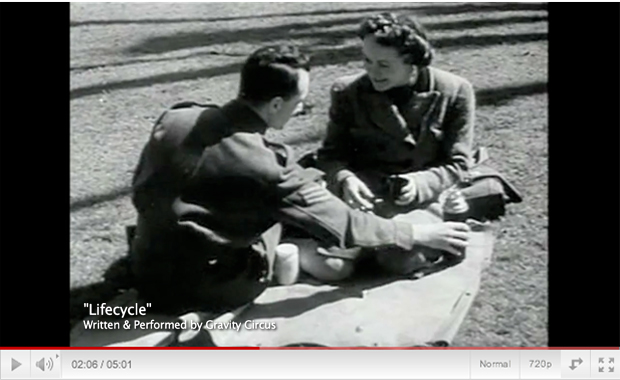
Lifecycle by Gravity Circus – Archive Mashup

TIME/IMAGE have collaborated with singer/songwriter Mike Neocleous of Gravity Circus to create a music video mash-up using footage from the British Council film archive.

Mike: “As the title suggests, the song is about the life cycle of human existence. It was mostly inspired by the theory of evolution, which I view as this almost magical life force that pushes through every living thing and which dictates our behaviour in a very subconscious or automatic way. It is also a comment on self-awareness and the idea that humans, unlike other animals, may have the capacity to influence evolution not just for humans but for all life on earth.

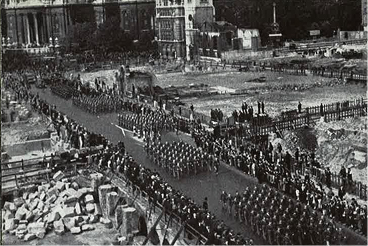
“Using archived footage of Britain from the 1940′s really helps to bring the whole meaning of the song home. Seeing soldiers in Trafalgar Square alongside children playing in the park, men clearing out a garden juxtaposed with men picking up rubble from a bomb site illustrates how easy it is for a society, even one as advanced as Britain, to descend into primitive in-group out-group struggle. 

“What really touched me emotionally was seeing the children evacuated from London, which I hope is what will touch others and help us all realise how important it is to try and guide our evolution towards progressing peacefully through unity rather than struggle.”

Films featured in the video are London 1942, Island People  and History of the English Language.

For more from Gravity Circus check out their Facebook & Myspace pages.

London 1942

Don’t Mention the War – The MOI’s Embargo on the British Council Film Department

London 1942Sam Milsom discusses information unearthed from files held the National Archives,which show how a minor inter-departmental misunderstanding drastically changed the direction of the British Council‘s films.


The British Council’s Medical Films

When TIME/IMAGE was first introduced to the British Council’s archive film collection, we quickly noticed that amongst the culturally-focused titles there were a handful of technical medical films. We thought they were a curiosity and perhaps a little out of keeping with the rest of the archive. Unable to locate much archive material on them via our usual avenues of research, we thought that maybe they were failed experiments or not widely distributed. In short, we paid them no special attention.Recently, however, we received an enquiry about the British Council’s medical films, and thus undertook to investigate more thoroughly. What we found was rather surprising.

At the beginning of World War Two, the Medical Research Council and the Ministry of Information asked Hugh Clegg, of the Royal Society of Medicine, “to prepare articles on British social medicine in order to counteract German propaganda against Britain. German articles in the foreign medical press declared that in Britain only the rich got treated while the poor suffered in silence” (1). Given, however, the effectiveness of Germany’s propaganda techniques, he proposed establishing a more long-term operation that would “inform the medical professions in other countries of the current achievements of British medicine” (2) in the same manner that the French and Germans had been doing before the war. Officials agreed, funding was found, and the British Medical Information Service created, providing translated abstracts from British periodicals to a large number of foreign journals. Continue reading