Skip to content

Archive for March, 2011

This week’s update from the National Archive

26/03/2011

timeimage

This week Sarah left me to my own devices as I spent a sunny afternoon down at the National Archives rifling through a file on the Imperial Relations Trust Film Committee…

Not to be confused with the Joint Film Committee of the Travel Association and British Council (see Sarah’s blog post for last week), the Imperial Relations Trust Film Committee was established in 1938 with the view of assessing the distribution of ‘Empire’ films between the UK and the Dominions and Colonies of the Empire. Its chief aims were to review the current distribution methods, to seek ways of increasing the supply and distribution of Empire films into the Dominions and Colonies, and to increase the supply of Dominion films into Great Britain.

Government funds were pumped into collecting research and gathering statistics on the proportion of Empire related films that were being distributed throughout the Dominions and Colonies in comparison to other films distributed but produced in other countries. This included both feature films and documentaries. Much of the Committee’s legwork was carried out by John Grierson, a name that continues to be synonymous with the Films of the British Council project. Grierson exploited his wide network of contacts, collaborating with many of the production and newsreel companies that he was at one time or another affiliated with to investigate whether Great Britain could compete in terms of distribution. He was also asked to advise the Committee on how to increase the supply and distribution of films into the Dominions and Colonies as well as make recommendations on what new films could be produced that the Committee deemed ‘suitable for Empire audiences’.

Subsequently, after investigating methods of distribution, the Committee began to build strong relationships with the Canadian and Australian governments, offering them grants to establish their own Film Committees under Grierson’s supervision. The promise of financial assistance towards the production of film in both Canada and Australia would have appealed to both governments but in many ways the deal was most beneficial for those concerned back in Britain. The replication of Britain’s own successful state-sponsored filmmaking structure in Canada, allowed the Imperial Relations Trust Film Committee to exert a degree of control over their investment, which they largely dedicated to increasing the number of Empire films available for distribution in Canada and increased the number of copies of existing Canadian films so that some of these new prints could be donated to the Imperial Film Library back in Britain.

Surprisingly, the British Council had little involvement with the Imperial Relations Trust Film Committee until their third Committee meeting when Philip Guedalla, the chairman of the Joint Film Association of the Travel Association and British Council, was invited to join the Committee.

Adam Field

Spot the Cameraman!

17/03/2011

timeimage

tumblr_li7a25rRk31qegdcco1_500

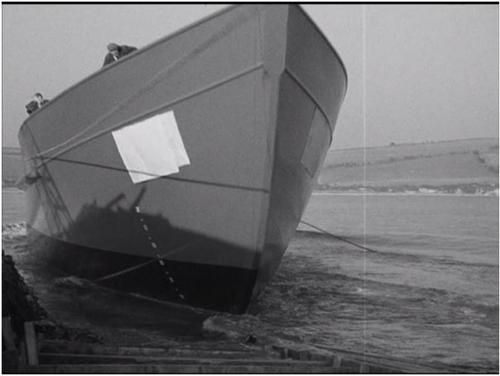
Upon watching the newly digitised British Council film “The Little Ships of England” (which will up and online very soon) on the BFI’s shiny new box-set “Tales From the Shipyard”, our eagled-eyed Sarah spotted a cameraman in hidden in plain sight!

The shot occurs during the launch of a newly-built ship, the filming of which utilises multi-cameras – one fixed camera taking the shot seen above, and another moving shot from the ship’s POV.

Is this an early case of self-reflexive filmmaking? Probably not. But it’s fun to see all the same.

British Council and the Distribution of Newsreels

15/03/2011

timeimage

The main focus of TIME/IMAGE’s work so far has been on the short documentary films that were commissioned by the British Council during the 1930’s and 40’s, but the Council was also involved in the supply and international distribution of British Newsreels. The nature of the Council’s work, a keen interest in cultural exchanges, and its expansive reach across the continents provided a suitable means in which the government could control the flow of information into countries abroad.

According to a letter, discovered last week at the National Archives, some of the News companies that produced reels for distribution also included specialist programs that were designed to act as propaganda. It states that Gaumont British News has ‘carried a considerable amount of news regarding the rearmament program in their news reel, and have prepared one or two special films, such as recruiting for the RAF and also ARP (Air Raid Precautions)’. The letter then outlines a suggestion that Gaumont British ‘prepare items specially designed to enhance British prestige abroad. Such items will be slipped into the newsreel when it is overseas, with suitable commentary.’

This overt attempt to export British propaganda into countries abroad did, however, raise some issues:

‘France, Belgium, Turkey, Czechoslovakia, Hungary, Holland, Denmark, Russia and the Balkan States, it would be possible to supply them with these specially made items for inclusion in their newsreel at no charge, although of course they would no doubt realise it was propaganda, but they would be tempted to use the material to fill up their reel. Newsreels in these countries, other than Russia, are not under the control of, or subsidised by the Governments, and it is felt they would welcome the opportunity. To evade the possibility of their knowing that these films were subsidised by this country, Gaumont-British could ask to be supplied with an equal amount of material from the country concerned. The advantage of this scheme would be that Gaumont-British would be able to include a considerable amount of prestige films in the newsreels going abroad, while no one would know they were being subsidised for doing so, or who is putting up the finance.’

To add to the secrecy, the letter was found in a British Council file addressed to Rowland Kenney of the Foreign Office but, judging by a lack of any signature, was sent from an unknown source. Very mysterious.

Films of the British Council catalogue wiki

10/03/2011

timeimage

tumblr_lhuofngtWO1qe62iq.bmp

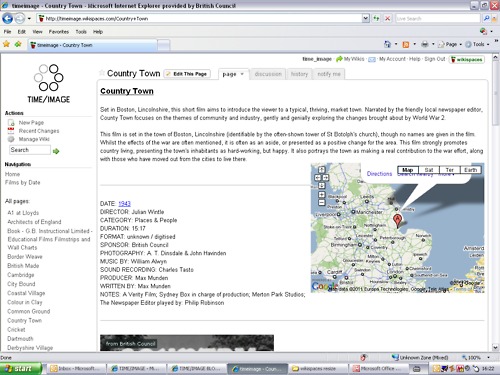
As some of you may have already noticed we have recently moved our existing html based catalogue of the British Council film archive to a wikispaces account: http://www.timeimage.wikispaces.com/ or http://www.wiki.timeimage.org.uk.

Wikispaces [http://www.wikispaces.com/], not to be confused with wikipedia, is a personal wiki creator. They are really usful for research, cataloging, and most importantly – collaborating.

One of our aims is to eventually integrate all our research on the British Council films into wikipedia – providing a massive platform for people to discover these great films. So for now we are developing the wiki pages – a particular style of web coding – in wikispaces. It’s quite a massive endeavour, and we are still the process of just adding our research into it, let alone formatting it all. Over the coming weeks it should begin really taking shape, so please keep checking back to see how we’re getting on.

The great thing with wikis is that, in theory, anyone can help edit / contribute to it. So if you would like to get involved in researching these films with us, and developing our wikispace – please get in touch!

This Week’s Update from the National Archive

10/03/2011

timeimage

Yesterday Adam and I dug in at the National Archives once again to see what we could dig up on the Travel & Industrial Development Association (otherwise known as TIDA) and how their film department came to morph into a British Council operation.

We learnt quite a bit.

—-

TIDA was conceived in the middle of 1928, the brainchild of Lord Waldorf Astor, with the aim of increasing the amount of American money spent in Britain by tourists. Lord Astor was supported in this venture by the then Chancellor of the Exchequer, Winston Churchill. It replaced the moribund “Come to Britain” movement, and was established officially in 1929 as the Travel Association of Great Britain and Ireland. It received a little under 25% of it’s funding from the government, which it constantly fought to retain for the next five years. The rest of its funding came from private companies who might benefit from an increase in tourism to Britain, and an impressive collection of individuals had a stake in the company – including still-recognisable names such as Lord Baden-Powell (founder of the Scout movement) and Gordon Selfridge (founder of Selfridges).

They had substantial success in America, and had offices in both New York and Paris, which resulted in the company also doing significant work on the Continent.

In February, 1932, the Travel Association, with the encouragement of the Board of Trade, changed its name to the Travel and Industrial Development Association of Great Britain and Ireland, with the added responsibility of promoting very industrial parts of England. Many councils subscribed to the services of TIDA. One of the most generous in its subscription was Lancashire, which might explain the existence of the film, So This is Lancashire.

TIDA established its own film department in 1932, and by March 1933, the company had, with the co-operation of the General Post Office Film Unit, added a number of new travel and industrial films to its library (though we cannot say that they produced them) which were shown overseas in the United States and on the Continent.

In 1935 the Department for Overseas Trade acknowledged that there was a little overlap between TIDA and the recently formed British Council for Relations with Other Countries (to later change its name to the British Council), and proposes giving the latter a grant five times the size of that given begrudgingly to TIDA.

In 1936 TIDA reports that:

“The Film Department has successfully proceeded with the task of building up a distributive system abroad for films descriptive of the British Isles. The documentary films The Key to Scotland and The Heart of an Empire were completed, and Beside the Seaside, a film of the South Coast, was produced with the co-operation of the Southern Railway and many South Coast Towns. Six documentary sound films have now been produced. Arrangements for the distribution of films were at once initiated. The films are of sufficient merit to be booked for cinema showing and they are being released in cinemas in this country as well as abroad during the next few months.

The Association has, in addition, five sound films for non-theatrical showing and twelve silent films. It is satisfactory to note that of eight short British documentary films selected by the Curators of the Film Library of Modern Art in New York, three were produced by the Association. The field for non-theatrical showing is large and increasing, indeed, the chief difficulty is the familiar one of finance, to produce enough copies of each film. Non-theatrical versions are prepared in 16mm. as well as 35mm. Sizes.”

Later that year, the British Council considered the use of films but decided to utilise the experience and machinery of the Association rather than to establish a new film unit. As a result, the ‘Joint Film Committee of the British Council and the Travel Association’ was set up. Chaired by Mr Philip Guedalla, the Foreign Office, Department of Overseas Trade, GPO and BFI were all represented on the Committee, for which TIDA provided secretarial and executive machinery.

Mr A.F Primrose was in charge of TIDA’s film department, and John Grierson (formerly of the Empire Marketing Board and GPO film units) was adviser. It also had its own facilities, with camera, cutting benches and vaults for storage. Several technical assistants were employed full time.

The Committee concluded that there were three classes of film activity considered for overseas distribution and display: British newsreels, British documentary films, and British fiction films. The last of these, the committee decided against seriously pursuing due to the fact that government policy was under review in connection with the Cinematograph Films Act.

Before the formation of the Joint Committee, TIDA had arranged the cinema display of documentary films in 21 countries. In most cases theatres made small payments to acquire the films. However, with the assistance of the British Council these arrangements were extended and in many countries it was necessary to distribute films for free.

By 1938:

“The Association has built up a library of documentary films, and with these it has obtained outlets in 54 countries, in 38 of which distribution is through cinemas. As mentioned, the British Council are represented on the Joint Committee for which the Association does the executive work, and they have supplied a small fund to enable films to be distributed free in certain countries. The demand has outrun the films available. The non-theatrical field is large, particularly with the coming of the 16mm. Sound film, and there is very wide circulation through educational film libraries. The importance of the circulation of British films is repeatedly stressed by British Government Representatives abroad.”

—-

So, we’ve learnt quite a lot! We’ll be updating our new TIME/IMAGE Wiki to include all of this new information as soon as possible. Check it out athttp://timeimage.wikispaces.com/

SARAH

%d bloggers like this: