Monthly Archives: February 2011

world_garden

Discovering Kew’s World Garden

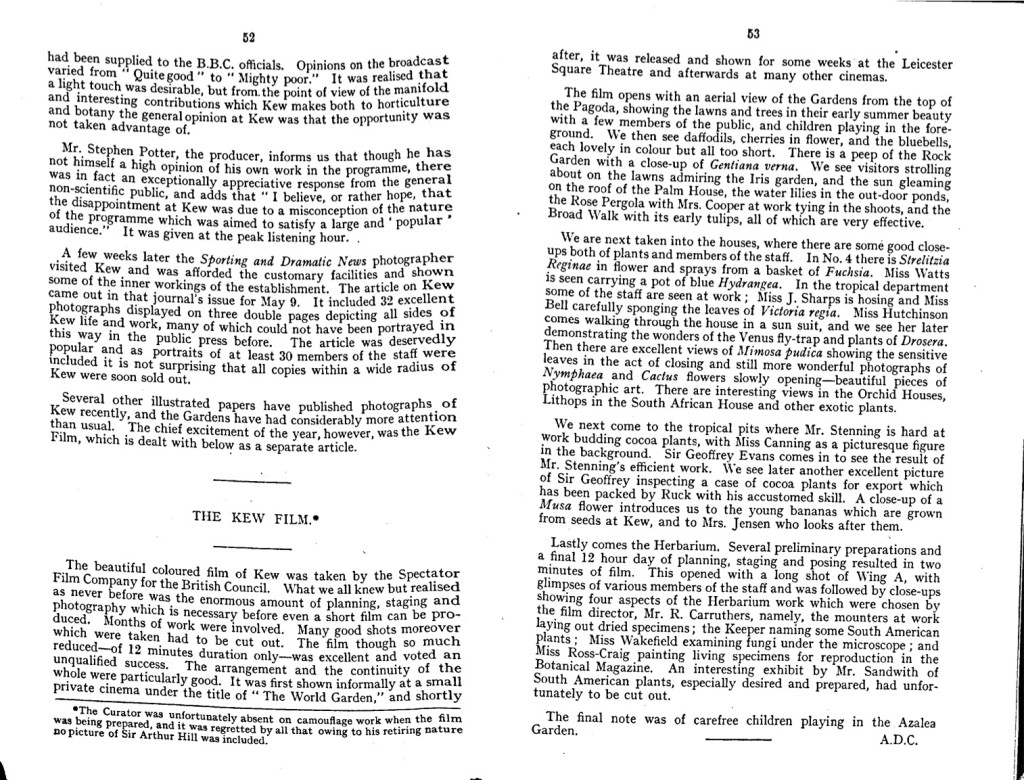
The production of World Garden arrived at a time when the British Council were re-evaluating their methods and approaches to filmmaking. Following the outbreak of war in 1939, the British Council found themselves in a vulnerable position. Government focus had switched away from building cultural relations and all efforts were being pumped into ensuring the Empire emerged victorious. The threat of the newly established Ministry of Information loomed large over the British Council and rumours circulated that a takeover might be imminent. To sustain itself during the war, the British Council used their overseas work to assist in gathering allied support and succeeded in creating a sympathetic representation of Great Britain abroad. Once the war was over the British Council’s operations would become of immense importance to the rebuilding of Great Britain’s relations with other countries.

In 1942 the British Council enlisted the expertise of Oliver Bell, the then director of the BFI, to produce a report that passed judgement over the current film output but also made recommendations and suggestions for new material. Bell was not thrilled by the films he saw, claiming that “many of them are competent, outstandingly so, but few of them show originality either in conception or execution”. Bell advised that the British Council needed to be more inventive in their approach to subject matter and film form.

“We want the council’s technique to develop; we seek originality even if it provokes criticism, but originality with a purpose, not merely sensationalism.”

Released the year before the BFI report was produced, World Garden was the film to which Bell and future film productions would refer to as standard. Although its concept is fairly straightforward – an exploration of the grounds and work that commences at the internationally renowned Kew Gardens – the deft use of Technicolor, the bold and vibrant colours, really does accentuate the beauty of the flowers and their surroundings. There’s also an intelligent use of time-lapse photography, where as if by magic flowers blossom right in front of your very eyes. As a result it comes as no surprise that World Garden was privileged with a UK theatrical release, premiering at Leicester Square theatre and then being shown more in widespread parts of the country and world, proving that the British Council were capable of producing informative films full of cinematic flourish.

Likewise, the recent re-discovery of World Garden has arrived at time when the films of the British Council are again being evaluated and transformed. Instead of focusing on technical innovations in production, the films are now receiving the benefits of the technical innovations in distribution, where they are entering the digital age and becoming a publicly accessible online resource. We caught up with Michele Losse, an archivist at Kew, whose chance discovery of an article about the film began its path to being beautifully restored and digitised. The enthusiasm of Kew Royal Botanical Gardens – and their own pursuit of the film in order to unlock a part of the institution’s heritage – was a very encouraging factor for the British Council when they began this project. Without World Gardenin the 1940s, the quality of the Council’s films wouldn’t be what they are; withoutWorld Garden being rediscovered today, we may never have had an idea of just how exceptional these films were.

To see more films about Kew Gardens please visit: http://www.kew.org/video/index.htm

Adam Field

A Time/Image Screening

Long Live Living British Cinema

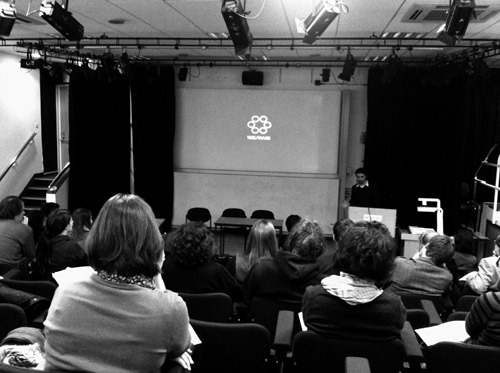
Last night Living British Cinema hosted their inaugural event at Queen Mary Univeristy of London and the TIME/IMAGE team was there to screen three films from the British Council Archive. The screening was preceded by a talk from Lucy Bolton and Charles Drazin, the founders of Living British Cinema, TIME/IMAGE’s very own Samuel Milsom issued a call to all budding filmmakers to get in touch with us to try their hand at some creative re-interpretations of the films, and finally Adam Field introduced the films Island People (1940), The Life of the Rabbit (1945)and General Election (1945).

Watch the talks below:

Education Education Education

Very early on we discovered that many of the films within the British Council film archive were commissioned or produced with the intent to distribute them across the world. This seemed fairly obvious given that the British Council’s primary objective is to build mutual trust and healthy relations between the United Kingdom and other countries. However, another large area of work the British Council invest a great deal of time in is education.

The other day, whilst I was conducting some research, I came across a document in the national archives on the British Council’s educational films. As I looked through various correspondences between the British Council Film department and other government bodies it became clear that the British Council recognised a potential within the medium of film to act as an alternative method of teaching. The council and other governmental departments involved were so keen to explore this idea that they encouraged practising teachers of the time to show British Council films to school children, which upon viewing the teacher would fill out a report based on the children’s reaction to the films. Teachers were also asked to form Teacher Film Groups where they could discuss the suitability of the films on a peer-to-peer basis. All of this information was eventually collected and collated by the Film department in order to attain feedback on their output.

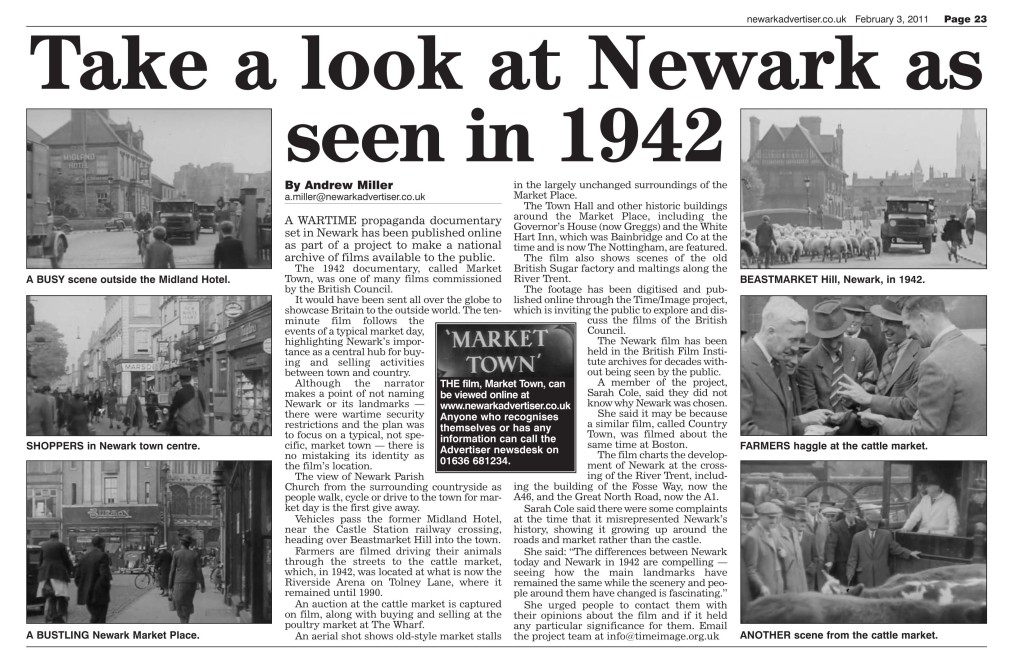
Some of the information I came across also gave some indication into the Film departments thinking behind the development of educational films, referring to many films not as individual films but as belonging to a series. In one report produced, summarising a Teachers Film Group reaction to Market Town, it states that ‘all groups were rather reserved in their criticisms as they had seen no other members of the series and its link-up with them is not known’. Another set of correspondence proposed a series of ‘citizenship’ films, which was not well received by the committee in charge of developing new output.

However, the most interesting find of the lot had to be the information on a series of films the British Council labelled the ‘biological series’. Three of these films were reviewed in the same report as Market Town - The Life Cycle of Pin Mould, The Life Cycle of Maize, The Life Cycle of the Newt. These life-cycle films, as TIME/IMAGE has dubbed them, received mixed reactions from Teacher Film Groups. Many criticisms were at aimed at films that skipped or missed a stage of the life cycle and there were also requests for more diagrammatic images to be used, but the most consistent criticism was towards the narration and commentary of the films where occasionally resentment towards the talking picture surfaced. I also found a letter from the Foreign Office enquiring to the Film department about the intended viewing age of Embryology of the Rabbit, which we know to be The Life of the Rabbit. The Film department’s response was that the film rounded ‘off a series that includes Sea Urchin, Development of the Chick, Development of the Trout andDevelopment of the Frog, all previously made by GB Instructional’ and that the intended age for these films were aimed at university degree level students. The letter continues to go on referring to a junior series intended for children 11 plus, which includes The Life Cycle of the Onion and a film that was currently in pre-production, which had been originally proposed as Behaviour of the Cat but had since changed to Behaviour of the Horse.

What is extraordinary about the mention of these films is that to TIME/IMAGE’s current knowledge Sea Urchin, Development of the Chick, Development of the Trout, Development of the Frog and Behaviour of the Horse are all not held at the BFI Film Archive. Should we imagine the worse case scenario? That these films could be lost forever. Let’s not. Let us hope that they are lying dormant in archive somewhere in the world, waiting to be rediscovered and reunited with their counterparts at the BFI.

ADAM

Click to enlarge

The Boston Standard

The United Kingdom, as a number of the digitised films observe, is a diverse land – of mountains and beaches, of fields and industry. To emphasise this, the British Council films focus on not just Britain as a whole, but as a heterogeneous country with distinct regions and peoples – highlighted through those films focusing on regional industry and settlement types.

Country Town (1943) is one of the ‘regional geography’ series, set in the town of Boston, Lincolnshire. Narrated by the friendly local newspaper editor (who may well have actually been the editor of the Lincolnshire Standard at the time), it looks at the work and leisure activities in this thriving market town.

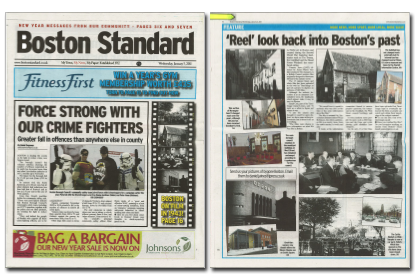
The Boston Standard, upon hearing about the film, got in touch and ran a rather lovely article (below) on the film, complete with now-and-then photo comparisons.

Click to enlarge

The ensuing response we’ve had from both former and present Boston residents has been fantastic. Many people have emailed us to express their enjoyment of the film, and Boston Council is looking to hold a screening in the town in the near future – we’ve even made contact with a gentleman who is seen as a child looking at the animal pens in the film itself.

It’s very encouraging to see that communities today are still very much interested in their local history and are keen to help us by providing information that we might not otherwise have encountered. A large part of this project is about engaging with the public and gathering their reactions to the films. As well as hearing people’s opinions on the films as documentary history, we want to see how they feel about the changing times and the way the films reflect the past, so it’s especially great to speak to people for whom the films hold a special significance.

We are planning to do more work with the regional films in the near future, and I for one hope that everywhere is as enthusiastic about their local history as Boston.

Sarah